

Norman Bridwell was an American author and illustrator who created Clifford the Big Red Dog, the children’s book series that has sold more than 126 million copies since its first title appeared in 1963. He worked as a struggling commercial artist for years before an editor at Harper & Row asked him to turn one of his drawings into a story, a request that changed the direction of children’s publishing.
Quick Facts About Norman Bridwell
| Detail | Information |
| Full name | Norman Ray Bridwell |
| Born | February 15, 1928, Kokomo, Indiana |
| Died | December 12, 2014, Martha’s Vineyard, Massachusetts |
| Occupation | Author and illustrator |
| Best known for | Clifford the Big Red Dog series |
| Spouse | Norma Howard Bridwell (married 1958) |
| Children | Emily Elizabeth Merz and Tim Bridwell |
| Books sold | Over 126 million copies in 13 languages |
Growing Up in Kokomo, Indiana
Bridwell was born on February 15, 1928, to Vern and Leona Bridwell. His father worked in a factory and his mother kept the household, and neither had a background in art or publishing. He drew constantly as a boy, though he later said he never rated his own work very highly next to his classmates.
At Kokomo High School in the 1940s, Bridwell felt he was always outmatched by other students in art and writing classes. A high school shop teacher once took his tools away and handed him a pad of paper instead, telling him to stick to drawing. That small nudge stayed with him for the rest of his life.
After graduating in 1945, he studied art at the John Herron School of Art in Indianapolis and later at Cooper Union in New York City. Both schools sharpened his drawing technique, though they gave him little sense of how to build a career out of it.
From Struggling Artist to Published Author
Bridwell moved to New York and worked as a freelance commercial artist through the 1950s and into the 1960s. Money was tight. He and his wife Norma were raising a young daughter, and freelance illustration work rarely provided a steady income.
Fifteen Rejections Before Clifford
In 1962, Bridwell put together a portfolio and tried to land steady work as a children’s book illustrator. Roughly fifteen publishing houses turned him down. Most editors felt his artwork was pleasant but not distinctive enough to carry a book on its own.
Bridwell later described those rejections as discouraging but not surprising, given how many illustrators were competing for the same small number of children’s book contracts in New York at the time. He kept the portfolio together and kept making rounds rather than shelving the project, a persistence he credited more to necessity than confidence.
At Harper & Row, an editor looked through his portfolio and picked out a drawing of a young girl standing beside a dog the size of a horse. Rather than reject the sketch outright, the editor suggested Bridwell write a short story to go with it. That single suggestion turned a rejected illustrator into a published author within a year.
How the Big Red Dog Got His Name
Bridwell originally wanted to name the dog Tiny, a joke aimed at the character’s enormous size. His wife, Norma, suggested Clifford instead, and the name stuck. The girl in the story, Emily Elizabeth, was named after their real daughter, a detail that gave the book a personal anchor Bridwell kept returning to in later titles.
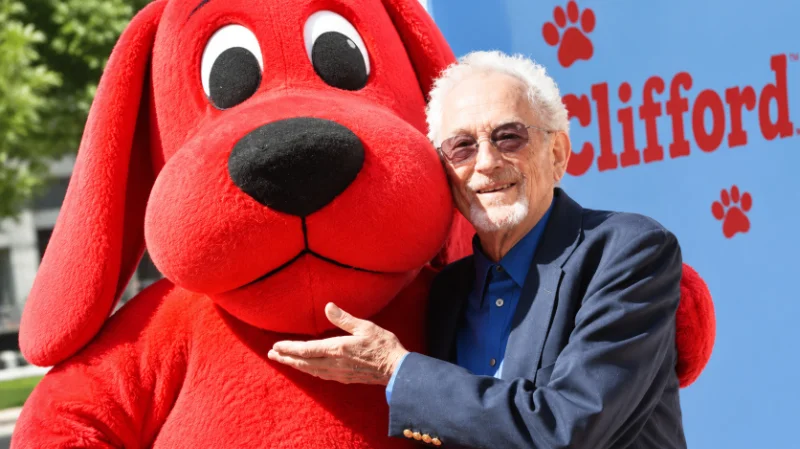
The finished manuscript combined the two elements editors had asked him to test separately: a memorable visual and a simple story built around it. That combination, rather than any single drawing or plot idea, turned out to be the real reason Clifford connected with readers where his earlier, unpublished submissions had not.
Harper & Row published Clifford the Big Red Dog in 1963. The book found an audience quickly among young readers and the teachers and librarians who bought copies for classrooms. Scholastic later took over the series and eventually made Clifford its official mascot.
The Witch Next Door and Bridwell’s Other Books
Clifford was not Bridwell’s only success. He brought The Witch Next Door to an editor meeting almost as an afterthought, alongside a new Clifford manuscript. He had sketched the witch character and thrown together a rough story the night before the meeting.
The book, published in 1965, became one of his most popular titles outside the Clifford series and led to five more books built around the same witch character. Bridwell also wrote and illustrated The Zany Zoo in 1963, What Do They Do When It Rains? in 1969, How to Care for Your Monster in 1970, and A Tiny Family in 1974.
None of these titles matched Clifford’s reach, but they showed a consistent style: gentle humor, simple line drawings, and stories built around ordinary childhood worries rather than complicated plots. That approach became something of a signature across his catalog.
Bridwell’s Approach to Writing and Illustration
Bridwell worked in a simple, rounded drawing style that stayed close to what he had used as a commercial artist before Clifford existed. He avoided detailed backgrounds and instead kept the focus on a small handful of characters, usually Clifford, Emily Elizabeth, and a rotating cast of neighborhood kids and pets.
He wrote most Clifford stories around everyday problems a young child could recognize: getting lost, misbehaving by accident, feeling too big or too different, or wanting to help but causing more mess instead. Clifford rarely spoke in the early books, and Bridwell let the dog’s size and expressions carry most of the emotional weight of a story.
Bridwell often said he wrote for the child reading the book, not for the adults reviewing it. He built each Clifford title to work as a read-aloud for a parent or teacher and as an early independent read once a child recognized the repeated words and simple sentence patterns. That dual purpose helped the books stay in classroom rotation long after their first printing.
Building the Clifford Franchise
Over five decades, the Clifford series grew to more than 90 books, not all written by Bridwell himself, since later titles were produced under license after his output slowed. The character expanded well beyond print. Three separate animated television series brought Clifford to a wider audience, along with a live musical stage show and branded merchandise sold through Scholastic’s school book fairs.
A live-action film adaptation reached theaters years after Bridwell’s death, a sign of how far the character had traveled from its origins as a single rejected sketch. Clifford also became closely tied to early literacy programs in American classrooms, where his books were often among the first a child would read independently.
By the time of Bridwell’s death, publishers had sold more than 126 million Clifford books in 13 languages. Few children’s book characters created by a single author have matched that combination of longevity and reach across formats.
Clifford’s Place in American Classrooms
Clifford’s biggest audience was never limited to bookstores. Scholastic built much of its early literacy programming around the character, distributing Clifford titles through school book fairs and classroom reading programs for decades. Teachers frequently picked Clifford books as a bridge between picture books read aloud and the first chapter books a child would tackle alone.
The animated television adaptations reinforced that role rather than replacing it. Episodes were built to pair with classroom themes such as friendship, honesty, and community, and many schools used the show alongside the books rather than instead of them. That pairing kept Clifford relevant to new generations of young readers well after Bridwell had stopped actively promoting the series in person.
Life on Martha’s Vineyard
Norman Bridwell married Norma Ellen Howard on June 13, 1958, after a three-year courtship. A mutual colleague introduced them, noting that both worked as commercial artists, both came from Indiana, and their first names were nearly identical. Their honeymoon took them to Martha’s Vineyard, a trip that drew the couple back for repeat vacations.

In 1969, the Bridwells settled permanently in Edgartown on Martha’s Vineyard, where they raised their two children, Emily Elizabeth and Tim. Norman worked from the island for the rest of his career, drawing Clifford from a home studio rather than a New York office. He remained a regular visitor to schools, where he told students about his own struggles with rejection before Clifford found a publisher.
Awards and Recognition
The Educational Paperback Association gave Bridwell the Jeremiah Ludington Memorial Award in 1991 for his contribution to children’s reading. In 1994, Indiana University, not far from his hometown of Kokomo, awarded him an honorary Doctor of Humane Letters degree.
Neither award drew the attention of major literary prizes, and critics rarely reviewed his books in depth. Bridwell himself pointed this out on more than one occasion, noting that Clifford’s popularity with children and teachers mattered more to him than recognition from specialists in children’s literature.
Bridwell’s more lasting recognition came from readers rather than award committees. He was a frequent guest at schools and library events, where he told the story of his fifteen rejections before Clifford was accepted. That story became something of a standard talk for him, aimed at students who assumed a published author had never struggled the way they did with a drawing or a school assignment.
Norman Bridwell’s Final Years
Bridwell continued producing Clifford titles well into his eighties, at one point averaging roughly two new books a year even as the franchise grew around him. He died on December 12, 2014, at Martha’s Vineyard Hospital at the age of 86. His wife told reporters he had prostate cancer and had been hospitalized for three weeks following a fall at their Edgartown home.
His funeral was held at the Federated Church in Edgartown, and he was cremated, with his ashes given to his son, Tim. Two final Clifford titles were published after his death, closing out a body of work that began with a single sketch an editor almost passed over.
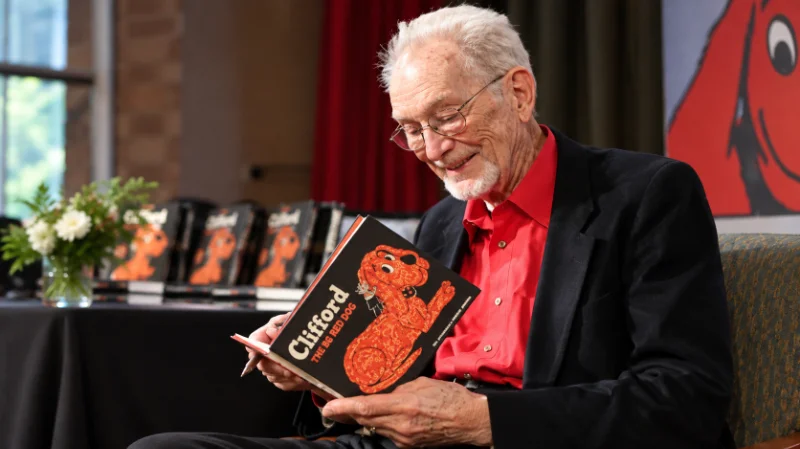
News of his death drew coverage well beyond the children’s publishing world, including obituaries from national newspapers and wire services that had rarely covered him during his career. Most of that coverage returned to the same detail: a man who considered his own drawings unremarkable had created one of the best-known characters in American children’s literature almost by accident.
Clifford the Big Red Dog outlived its creator by design as much as by accident. Scholastic continued the character as its mascot, the animated series stayed in rotation, and new readers kept discovering the books through school libraries decades after Bridwell first submitted his rejected portfolio to fifteen publishers.